
World
Influential Philosopher Jürgen Habermas Passes Away at 96

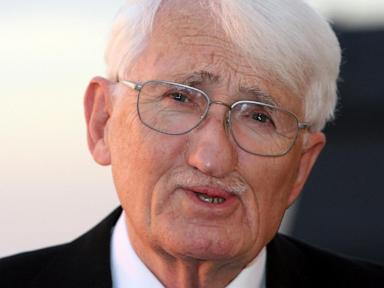
Renowned philosopher Jürgen Habermas has died at the age of 96, as confirmed by his publisher Suhrkamp. He passed away on Saturday in Starnberg, near Munich. Habermas, celebrated for his contributions to communication theory, sociology, and political discourse, leaves behind a significant legacy that has shaped modern philosophical thought.
Legacy of a Leading Intellectual
Throughout his long career, Habermas engaged deeply with political and social issues, becoming a pivotal figure in German intellectual life. His most notable work, the two-volume Theory of Communicative Action, explored the dynamics of communication and rationality within society. This foundational text remains influential across multiple disciplines.
Born on June 18, 1929, in Düsseldorf, Habermas experienced the profound shifts in Germany following World War II. Reflecting on the defeat of Nazi Germany at the age of 15, he recognized the importance of grappling with the historical realities of that period. He noted, “you saw suddenly that it was a politically criminal system in which you had lived,” a realization that would profoundly influence his philosophical outlook.
Engagement with Political Movements
Habermas’s relationship with the left-wing student movement of the late 1960s was complex. He engaged with the movement, which sought social change, while simultaneously warning against what he termed “left-wing fascism.” This perspective emerged after a controversial speech by a student leader, which he later described as “slightly out of place.” Despite this, he acknowledged the movement’s role in promoting a “fundamental liberalization” of German society.
In the 1980s, Habermas became a prominent voice in the so-called Historians’ Dispute, which revolved around interpretations of the Third Reich. Opposing historians like Ernst Nolte, Habermas argued that attempts to equate Nazi atrocities with those committed by other regimes undermined the unique horror of the Holocaust. He contended that such comparisons were efforts to diminish the significance of Nazi crimes.
Habermas supported the election of center-left Chancellor Gerhard Schröder in 1998, later criticizing the “technocratic” approach of his conservative successor, Angela Merkel. He expressed concern in 2016 about the “foam blanket of Merkel’s policy of sending people to sleep,” reflecting his discontent with the political landscape.
In 2017, he praised the newly elected French President Emmanuel Macron for his vision of European reform, stating that “the way he speaks about Europe makes a difference.” This endorsement demonstrated Habermas’s commitment to a politically effective Europe, a cause he felt was inadequately addressed by German political leaders and the media.
Habermas’s personal life was marked by both triumph and tragedy. He faced numerous health challenges throughout his early years, including a cleft palate that required multiple surgeries. This experience informed his understanding of language’s role in human interaction. He remarked on the importance of spoken language as “a layer of commonality without which we as individuals cannot exist” and noted the “superiority of the written word.”
He is survived by his three children: Tilmann, Judith, and Rebekka, who passed away in 2023. His wife, Ute Habermas-Wesselhoeft, died the previous year. His passing marks the end of an era for many who valued his insights into philosophy, society, and politics.

Fort Worth Hosts Exciting Hometown Half Marathon and 5K/10K Events

Navy Launches Five New Acquisition Executives to Streamline Processes

Utah Mother Kouri Richins Accused of Poisoning Husband for Money

Oil Prices Surge, U.S. Stocks Show Unexpected Resilience

Cyberpunk 2077 Set for PS5 Pro Performance Update Soon

Home Assistant Tool Enhances Server Health with Global Score

Oregon Ducks Unveil Nature-Inspired Nike Air Max 95 Sneakers

Trump Administration’s Legal Tactics Intensify at the Border

Sandia Scientists Recognized as National Academy of Inventors Fellows

Libraries Challenge Rising E-Book Costs Amid Growing Demand

Tyreek Hill Responds to Tua Tagovailoa’s Comments on Team Dynamics

Liverpool Secures Agreement to Sign Young Striker Will Wright

San Francisco Hosts Unique Contest to Identify “Performative Males”

Save Your Split Tomatoes: Expert Tips for Gardeners

Elon Musk Sculpture Travels From Utah to Yosemite National Park

Princess Beatrice’s Daughter Athena Joins Siblings at London Parade

Astronomers Unveil Insights from β Pictoris b Using GRAVITY

Winter Storms Lash New South Wales with Snow, Flood Risks
-
 Lifestyle8 months ago
Libraries Challenge Rising E-Book Costs Amid Growing Demand
-
 Sports8 months ago
Tyreek Hill Responds to Tua Tagovailoa’s Comments on Team Dynamics
-
 Sports8 months ago
Liverpool Secures Agreement to Sign Young Striker Will Wright
-
 Science7 months ago
San Francisco Hosts Unique Contest to Identify “Performative Males”
-
 Lifestyle8 months ago
Save Your Split Tomatoes: Expert Tips for Gardeners
-
 Sports8 months ago
Elon Musk Sculpture Travels From Utah to Yosemite National Park
-
 Lifestyle8 months ago
Princess Beatrice’s Daughter Athena Joins Siblings at London Parade
-
 Science6 months ago
Astronomers Unveil Insights from β Pictoris b Using GRAVITY
-
 World8 months ago
Winter Storms Lash New South Wales with Snow, Flood Risks
-
 Science8 months ago
Trump Administration Moves to Repeal Key Climate Regulation
-

 Sports8 months ago
Bubba Wallace Makes History with Brickyard 400 Victory
-

 Business8 months ago
SoFi Technologies Shares Slip 2% Following Insider Stock Sale