
Top Stories
Weather Conditions Help Set Olympic Records in Men’s 1,500 Meters

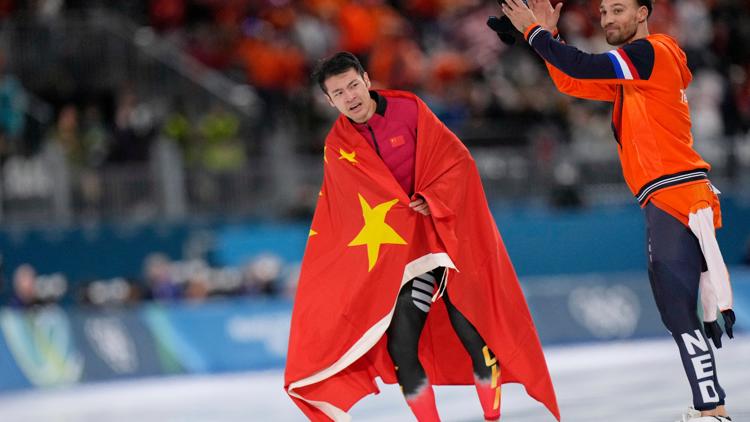
Weather conditions outside the speedskating oval in Milan played a surprising role in the outcome of the men’s 1,500 meters event during the Milan Cortina Olympics. On February 8, 2026, competitors took advantage of lower air pressure, which commentators noted as being the lowest recorded during the Games. This atmospheric phenomenon contributed to ideal conditions for speed skating, enabling athletes to achieve remarkable times.
During the competition, it became evident that the unusual weather had a significant impact on performance. One commentator highlighted the benefits of the low air pressure, explaining, “The conditions are as good as they could be for fast skating here in Milan,” adding that this atmospheric state is advantageous within the rink. The commentator further clarified, “Bad weather outside often means good times inside. We could see some fast times today.”
Indeed, the predictions proved accurate as the event unfolded. Joep Wennemars of the Netherlands set an Olympic record with a time of 1:42.90. However, this record was quickly surpassed by Zhongyan Ning of China, who claimed gold just minutes later, finishing with a time of 1:41.98. Ning’s achievement not only secured him the top spot on the podium but also marked a new Olympic benchmark.
The science behind these impressive performances is rooted in the principles of aerodynamics. Speed skaters contend with air resistance, which can significantly affect their speed. According to Robert Chapman, an exercise physiologist at Indiana University, “It’s a little counterintuitive because we usually think altitude slows people down, but in speed skating, it’s the other way around.” He explained that denser air creates more resistance, requiring skaters to exert additional effort to maintain high speeds. Conversely, thinner air reduces this resistance, allowing for faster times.
The record-breaking performances in the men’s 1,500 meters highlight the intriguing relationship between weather conditions and athletic achievement. As athletes continue to push the boundaries of speed, the impact of environmental factors remains a crucial aspect of their performance. The success of Wennemars and Ning at the Milan Cortina Olympics serves as a testament to the influence of seemingly unrelated factors, such as weather, on the world of sports.

Fort Worth Hosts Exciting Hometown Half Marathon and 5K/10K Events

Navy Launches Five New Acquisition Executives to Streamline Processes

Utah Mother Kouri Richins Accused of Poisoning Husband for Money

Oil Prices Surge, U.S. Stocks Show Unexpected Resilience

Cyberpunk 2077 Set for PS5 Pro Performance Update Soon

Home Assistant Tool Enhances Server Health with Global Score

Oregon Ducks Unveil Nature-Inspired Nike Air Max 95 Sneakers

Trump Administration’s Legal Tactics Intensify at the Border

Sandia Scientists Recognized as National Academy of Inventors Fellows

Libraries Challenge Rising E-Book Costs Amid Growing Demand

Tyreek Hill Responds to Tua Tagovailoa’s Comments on Team Dynamics

San Francisco Hosts Unique Contest to Identify “Performative Males”

Liverpool Secures Agreement to Sign Young Striker Will Wright

Save Your Split Tomatoes: Expert Tips for Gardeners

Elon Musk Sculpture Travels From Utah to Yosemite National Park

Astronomers Unveil Insights from β Pictoris b Using GRAVITY

Princess Beatrice’s Daughter Athena Joins Siblings at London Parade

University of Hawaiʻi Joins $25M AI Initiative to Monitor Disasters
-
 Lifestyle9 months ago
Libraries Challenge Rising E-Book Costs Amid Growing Demand
-
 Sports8 months ago
Tyreek Hill Responds to Tua Tagovailoa’s Comments on Team Dynamics
-
 Science8 months ago
San Francisco Hosts Unique Contest to Identify “Performative Males”
-
 Sports8 months ago
Liverpool Secures Agreement to Sign Young Striker Will Wright
-
 Lifestyle9 months ago
Save Your Split Tomatoes: Expert Tips for Gardeners
-
 Sports9 months ago
Elon Musk Sculpture Travels From Utah to Yosemite National Park
-
 Science6 months ago
Astronomers Unveil Insights from β Pictoris b Using GRAVITY
-
 Lifestyle8 months ago
Princess Beatrice’s Daughter Athena Joins Siblings at London Parade
-
Science5 months ago
University of Hawaiʻi Joins $25M AI Initiative to Monitor Disasters
-
 World8 months ago
Winter Storms Lash New South Wales with Snow, Flood Risks
-

 Sports9 months ago
Bubba Wallace Makes History with Brickyard 400 Victory
-

 Science9 months ago
California Develops New Method to Monitor Toxic Algal Blooms