
Science
NASA’s Artemis II Mission Set to Unlock Lunar Secrets

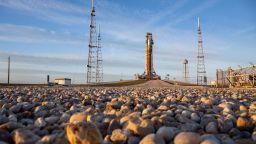
When NASA’s Artemis II mission launches in early March 2024, it will embark on a groundbreaking ten-day journey around the moon. This mission aims to provide astronauts with a unique view of the lunar far side, a region that has remained unexplored by human eyes until now. The Artemis II mission represents a significant milestone, marking the first human approach to the moon in over five decades and paving the way for renewed exploration that could answer long-standing scientific questions about Earth’s natural satellite.
Jeff Andrews-Hanna, a professor at the University of Arizona‘s Lunar and Planetary Laboratory, highlighted the importance of this mission. He noted that despite centuries of observation and previous manned missions, many fundamental aspects of the moon remain elusive. The Apollo missions, which took place in the late 1960s and early 1970s, provided critical samples that shaped our understanding of the moon’s composition and origin. Recent analysis of these samples has even revealed the unexpected presence of water trapped in rocks previously thought to be dry.
While the Apollo missions primarily explored the near side of the moon, where the terrain is relatively flat, the Artemis program will focus on diverse lunar regions. This could lead to a more comprehensive understanding of the moon’s landscape and its evolutionary history. Scientists are particularly interested in exploring the differences between the near and far sides of the moon, the amount of water present, and how the moon has changed over time.
The investigation of lunar features could also illuminate aspects of Earth’s early history. As Noah Petro, chief of NASA’s Planetary, Geology, Geophysics and Geochemistry Laboratory, pointed out, studying the moon is akin to examining an extension of Earth itself. He emphasized the potential for unexpected discoveries, stating, “We will have surprises. That’s why we explore. If we knew what we would find, we wouldn’t have to go.”
Unlocking Lunar Mysteries
The Apollo missions unearthed valuable information about the moon, but they also raised new questions. The far side of the moon is notably different from the near side, exhibiting a thick crust and higher elevations, with far fewer signs of volcanic activity. Andrews-Hanna stressed that this asymmetry is one of the biggest mysteries in lunar science today.
The presence of KREEP, a geochemical component rich in radioactive elements, on the near side adds to the complexity. Meanwhile, the far side’s geological characteristics remain largely unexplored. Understanding these differences is crucial, as they have implications for the moon’s evolution and the history of planetary formation in our solar system. Andrews-Hanna stated, “The moon is lopsided in nearly every respect, and we don’t know why.”
As scientists prepare for Artemis II, they are also looking ahead to future missions. The upcoming Artemis III mission, scheduled for 2028, aims to land astronauts on the lunar surface, specifically at the south pole region. Observations from Artemis II will help determine optimal landing sites for these future explorations.
During the Artemis II mission, astronauts will fly approximately 4,000 to 6,000 miles (6,437 to 9,656 kilometers) above the lunar surface, capturing images of impact craters and ancient lava flows. The crew, which includes NASA astronauts Reid Wiseman, Victor Glover, and Christina Koch, along with Jeremy Hansen from the Canadian Space Agency, has undergone extensive training in geology to enhance their observational skills and scientific contributions during the mission.
Future Discoveries and Implications
The Artemis missions are positioned not only to investigate the moon but also to lay the groundwork for future human exploration of Mars. The technological advancements and infrastructure developed during these lunar missions will be crucial for longer-duration missions to the Red Planet. Petro remarked, “If we understand those three objects, we have a good understanding of how planets anywhere would work. And the moon is the best place to start making those discoveries.”
The Artemis II mission is expected to provide unique insights into the moon’s surface, including potential observations of previously shadowed areas such as the Orientale Basin, a transition zone between the near and far sides of the moon. The crew may also witness meteoroids striking the lunar surface, offering real-time data on the moon’s environment.
The ongoing exploration is driven by a desire to uncover the moon’s secrets, including the potential for water ice in permanently shadowed regions. The quest to understand the origins of lunar water could further inform theories about Earth’s own water sources. As Barbara Cohen, project scientist for the Artemis IV mission, noted, samples collected could yield crucial information about the early solar system.
With each mission, scientists aim to construct a more complete picture of the moon’s history and its role in the evolution of Earth. The Artemis program, often referred to as the moon to Mars initiative, promises to unlock the mysteries of our celestial neighbor while preparing humanity for future exploration beyond our planet.

Fort Worth Hosts Exciting Hometown Half Marathon and 5K/10K Events

Navy Launches Five New Acquisition Executives to Streamline Processes

Utah Mother Kouri Richins Accused of Poisoning Husband for Money

Oil Prices Surge, U.S. Stocks Show Unexpected Resilience

Cyberpunk 2077 Set for PS5 Pro Performance Update Soon

Home Assistant Tool Enhances Server Health with Global Score

Oregon Ducks Unveil Nature-Inspired Nike Air Max 95 Sneakers

Trump Administration’s Legal Tactics Intensify at the Border

Sandia Scientists Recognized as National Academy of Inventors Fellows

Libraries Challenge Rising E-Book Costs Amid Growing Demand

Tyreek Hill Responds to Tua Tagovailoa’s Comments on Team Dynamics

San Francisco Hosts Unique Contest to Identify “Performative Males”

Liverpool Secures Agreement to Sign Young Striker Will Wright

Save Your Split Tomatoes: Expert Tips for Gardeners

Elon Musk Sculpture Travels From Utah to Yosemite National Park

Astronomers Unveil Insights from β Pictoris b Using GRAVITY

Princess Beatrice’s Daughter Athena Joins Siblings at London Parade

University of Hawaiʻi Joins $25M AI Initiative to Monitor Disasters
-
 Lifestyle9 months ago
Libraries Challenge Rising E-Book Costs Amid Growing Demand
-
 Sports8 months ago
Tyreek Hill Responds to Tua Tagovailoa’s Comments on Team Dynamics
-
 Science8 months ago
San Francisco Hosts Unique Contest to Identify “Performative Males”
-
 Sports9 months ago
Liverpool Secures Agreement to Sign Young Striker Will Wright
-
 Lifestyle9 months ago
Save Your Split Tomatoes: Expert Tips for Gardeners
-
 Sports9 months ago
Elon Musk Sculpture Travels From Utah to Yosemite National Park
-
 Science6 months ago
Astronomers Unveil Insights from β Pictoris b Using GRAVITY
-
 Lifestyle8 months ago
Princess Beatrice’s Daughter Athena Joins Siblings at London Parade
-
Science5 months ago
University of Hawaiʻi Joins $25M AI Initiative to Monitor Disasters
-

 World8 months ago
Winter Storms Lash New South Wales with Snow, Flood Risks
-

 Sports9 months ago
Bubba Wallace Makes History with Brickyard 400 Victory
-

 Science9 months ago
California Develops New Method to Monitor Toxic Algal Blooms