
World
Indigenous Artifacts Return to Canada After Century in Vatican

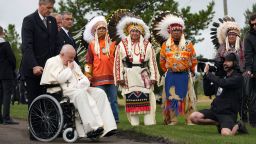
Indigenous leaders celebrated a significant milestone on March 9, 2024, as over 60 cultural artifacts, including a rare Inuit sealskin kayak, returned to Canada after being held in the Vatican for more than a century. The artifacts, which were taken from First Nations, Inuit, and Méti communities, were transported to Montreal’s Pierre Elliott Trudeau International Airport, marking a momentous homecoming for Indigenous communities across the nation.
The repatriation of these items is the culmination of a three-year campaign led by Indigenous representatives, which received support from the late Pope Francis. His endorsement followed his historic apology for the abuses committed against Indigenous peoples in Canada at church-run residential schools. The return of the artifacts reflects a growing trend among museums worldwide to return items acquired through unethical means to their rightful communities.
First Nations National Chief Cindy Woodhouse Nepinak expressed the emotional significance of the artifacts’ return during a press conference. “This is an important and emotional moment for many First Nations across the country,” she stated, while also acknowledging the ongoing challenges in the reconciliation process. “We’ve come a long way, and we have a long way to go.”
Controversial Origins
While the repatriated artifacts represent a small fraction of the thousands of colonial-era Indigenous objects held by the Vatican, their origins are disputed. Among the 62 items is the Inuvialuit sealskin kayak, which was the last artifact to be unloaded from the plane. These items were initially brought to Rome for the 1925 Vatican Mission Exposition, an exhibit aimed at showcasing the Church’s global influence.
The Vatican has maintained that the artifacts were gifted to Pope Pius XI, who led the Church from 1922. However, this assertion has been challenged by Indigenous groups in Canada, who argue that the items were taken during a time when Indigenous identity was systematically suppressed through legislation and the forced attendance of children at residential schools designed to erase their cultures.
Cody Groat, an Assistant Professor of History and Indigenous Studies at Canada’s Western University, noted the complexity of the term “gifting” in this context. “Given the historical backdrop, it’s highly contestable that this was a meaningful ‘gifting’ of items,” he explained in an email.
Calls for repatriation intensified in 2022 when a delegation of First Nations, Inuit, and Méti representatives visited Rome to discuss historical injustices with Pope Francis. This trip was followed by the Pope’s penitential pilgrimage to Canada, during which he apologized for the Church’s role in the suffering of Indigenous peoples. The late pontiff pledged to return the artifacts, with the responsibility ultimately falling to his successor, Pope Leo.
A New Chapter
In February 2024, the Holy See and the Canadian Conference of Catholic Bishops announced that the artifacts, along with their documentation, would be returned to Indigenous communities. This decision was framed as the conclusion of a journey initiated by Pope Francis. Groat expressed optimism regarding Pope Leo’s early actions in his papacy, suggesting it may foster improved relationships between the Catholic Church and Indigenous peoples in Canada and beyond.
The artifacts are currently at the Canadian Museum of History in Gatineau, Quebec, near Ottawa. Indigenous leaders are now tasked with determining new homes for these significant cultural items. Natan Obed, President of Inuit Tapiriit Kanatami, expressed eagerness for this next phase. “We are looking forward to being able to unbox the items in the coming days and to have Inuit leadership and Inuit experts understand exactly where these items come from in each of our communities,” he said during a press conference.
The return of these artifacts is not merely an act of repatriation; it resonates deeply within Indigenous communities, where such objects are regarded as “cultural ancestors with a sentience or life of their own.” Groat emphasized the importance of these items in revitalizing cultural practices, stating, “These cultural ancestors are now able to rejoin our communities and help with the continuity and revitalization of our cultural practices.”
As these artifacts find their way home, the journey towards reconciliation and acknowledgment of historical injustices continues, highlighting the need for ongoing dialogue and understanding between Indigenous peoples and institutions like the Catholic Church.

Lando Norris Secures First Formula 1 Title at Abu Dhabi Grand Prix

German Industrial Production Surges Ahead of Major Investments

Stephanie Ruhle Challenges Viewer Perceptions of Legacy Media

States Pull Back on GLP-1 Drug Coverage Amid Budget Cuts

Juliette Binoche Discusses Directorial Debut and Future Projects

John Cena Surprises Fans at Bayley’s Lodestone 2025 Camp Ahead of Farewell

Indigenous Artifacts Return to Canada After Century in Vatican

Japanese Yen Rises as Wage Growth Sparks Rate Hike Speculation

Japanese Yen Rises on Strong Wage Growth Amid Fed Rate Cut Anticipation

Libraries Challenge Rising E-Book Costs Amid Growing Demand

Tyreek Hill Responds to Tua Tagovailoa’s Comments on Team Dynamics

Liverpool Secures Agreement to Sign Young Striker Will Wright

Save Your Split Tomatoes: Expert Tips for Gardeners

Princess Beatrice’s Daughter Athena Joins Siblings at London Parade

San Francisco Hosts Unique Contest to Identify “Performative Males”

Winter Storms Lash New South Wales with Snow, Flood Risks

Trump Administration Moves to Repeal Key Climate Regulation

SoFi Technologies Shares Slip 2% Following Insider Stock Sale
-
 Lifestyle5 months ago
Libraries Challenge Rising E-Book Costs Amid Growing Demand
-
 Sports4 months ago
Tyreek Hill Responds to Tua Tagovailoa’s Comments on Team Dynamics
-
 Sports4 months ago
Liverpool Secures Agreement to Sign Young Striker Will Wright
-
 Lifestyle4 months ago
Save Your Split Tomatoes: Expert Tips for Gardeners
-
 Lifestyle4 months ago
Princess Beatrice’s Daughter Athena Joins Siblings at London Parade
-
 Science4 months ago
San Francisco Hosts Unique Contest to Identify “Performative Males”
-
 World4 months ago
Winter Storms Lash New South Wales with Snow, Flood Risks
-
 Science5 months ago
Trump Administration Moves to Repeal Key Climate Regulation
-
 Business5 months ago
SoFi Technologies Shares Slip 2% Following Insider Stock Sale
-

 Science5 months ago
New Tool Reveals Link Between Horse Coat Condition and Parasites
-
 Sports5 months ago
Elon Musk Sculpture Travels From Utah to Yosemite National Park
-
 Science5 months ago
New Study Confirms Humans Transported Stonehenge Bluestones