
Science
Scientists Discover Earliest Galaxy Cluster Formation Using JWST

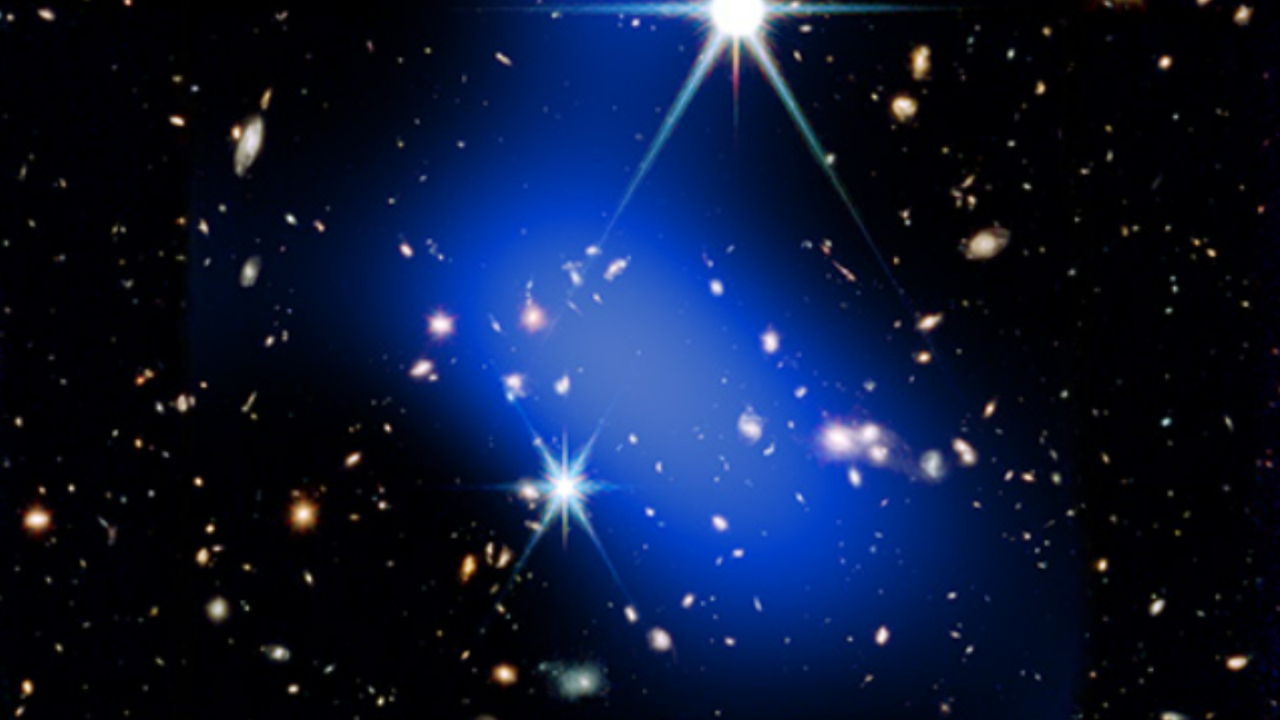
Using the James Webb Space Telescope (JWST) in conjunction with NASA’s Chandra X-ray Observatory, scientists have identified the most distant galaxy cluster ever observed in the universe’s early history. This protocluster, designated JADES-ID1, was forming just 1 billion years after the Big Bang, significantly earlier than previously believed possible.
The light from JADES-ID1 has traveled for 12.7 billion years to reach Earth, allowing astronomers to witness a formative period occurring 1 billion to 2 billion years earlier than earlier models suggested. This discovery raises critical questions about how galaxy clusters—massive structures held together by gravity—could develop so swiftly in the cosmos.
Significant Findings Challenge Existing Models
According to Akos Bogdan, team leader at the Center for Astrophysics | Harvard & Smithsonian (CfA), “This may be the most distant confirmed protocluster ever seen. JADES-ID1 is giving us new evidence that the universe was in a huge hurry to grow up.” The observations challenge long-standing models of galaxy formation, which did not anticipate such rapid development so soon after the universe’s inception.
Galaxy clusters consist of thousands of galaxies, extensive clouds of hot gas, and dark matter, which is largely invisible but plays a crucial role in the formation of structures in the universe. These clusters not only help ascertain the dark matter content but also assist astronomers in calculating the expansion rate of the universe.
Team member Gerrit Schellenberger emphasized the importance of observing the growth of galaxy clusters, stating, “It’s like watching an assembly line make a car, rather than just trying to figure out how a car works by looking at the finished product.” The combination of observations from JWST and Chandra elucidated JADES-ID1’s status as a protocluster through two main characteristics: the gravitationally bound galaxies observed by JWST and a surrounding cloud of hot gas detected via X-ray emissions by Chandra.
Implications for Understanding Cosmic Evolution
This hot gas, which is falling into the protocluster, becomes intensely heated, generating X-rays. Current models suggest that the galaxy density observed in JADES-ID1 should not have been achievable merely 1 billion years after the Big Bang. Previously, the earliest known protocluster existed around 3 billion years post-Big Bang.
The researchers anticipate that over billions of years, JADES-ID1 will evolve into a galaxy cluster similar to those found in the contemporary universe. Qiong Li from the University of Manchester remarked, “We thought we’d find a protocluster like this two or three billion years after the Big Bang—not just one billion.” This finding aligns with previous discoveries of large galaxies and black holes emerging shortly after the Big Bang, indicating a pattern of rapid growth.
The findings from this influential study were published on January 28, 2024, in the journal Nature. As scientists continue to investigate JADES-ID1 and its implications, the discovery marks a significant advancement in our understanding of the early universe and the formation of complex cosmic structures.

Knowles CEO Jeffrey Niew Divests Shares Worth Nearly $2 Million

Echo Financial Expands Advisory Services to Higher Education Sector

Luc Besson’s ‘Dracula’ Reimagines Classic Tale as Romantic Drama

Citigroup Lowers IQVIA Price Target to $200, Analysts Respond

Discover Detroit: A Walking Tour Through Its Rich History

Study Reveals Off-Pump CABG Reduces Perioperative Risks

NY Pie Expands with New Location in Nashville’s Capitol View

Rogers Communication vs. PT Telekomunikasi: A Comparative Analysis

Researchers Uncover Genetic Links to Parkinson’s Disease Risk

Libraries Challenge Rising E-Book Costs Amid Growing Demand

Tyreek Hill Responds to Tua Tagovailoa’s Comments on Team Dynamics

Liverpool Secures Agreement to Sign Young Striker Will Wright

Save Your Split Tomatoes: Expert Tips for Gardeners

San Francisco Hosts Unique Contest to Identify “Performative Males”

Princess Beatrice’s Daughter Athena Joins Siblings at London Parade

Elon Musk Sculpture Travels From Utah to Yosemite National Park

Winter Storms Lash New South Wales with Snow, Flood Risks

Trump Administration Moves to Repeal Key Climate Regulation
-
 Lifestyle7 months ago
Libraries Challenge Rising E-Book Costs Amid Growing Demand
-
 Sports6 months ago
Tyreek Hill Responds to Tua Tagovailoa’s Comments on Team Dynamics
-
 Sports6 months ago
Liverpool Secures Agreement to Sign Young Striker Will Wright
-
 Lifestyle6 months ago
Save Your Split Tomatoes: Expert Tips for Gardeners
-
 Science6 months ago
San Francisco Hosts Unique Contest to Identify “Performative Males”
-
 Lifestyle6 months ago
Princess Beatrice’s Daughter Athena Joins Siblings at London Parade
-
 Sports7 months ago
Elon Musk Sculpture Travels From Utah to Yosemite National Park
-
 World6 months ago
Winter Storms Lash New South Wales with Snow, Flood Risks
-
 Science7 months ago
Trump Administration Moves to Repeal Key Climate Regulation
-

 Business7 months ago
SoFi Technologies Shares Slip 2% Following Insider Stock Sale
-

 Science7 months ago
New Tool Reveals Link Between Horse Coat Condition and Parasites
-

 Sports6 months ago
Bubba Wallace Makes History with Brickyard 400 Victory