
Science
Rethinking Climate Migration: Introducing ‘Tethered Resilience’

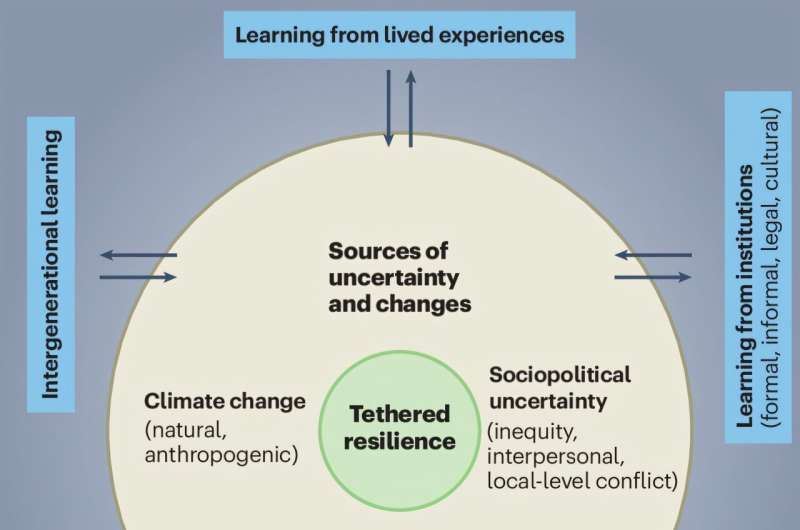
Communities affected by climate change increasingly face difficult choices regarding their future. A recent commentary in Nature Climate Change, co-authored by Brianna Castro, assistant professor of urban sustainability at Yale University, proposes an alternative framework—referred to as “tethered resilience.” This concept challenges the traditional binary of “move” or “stay,” offering a more nuanced understanding of how individuals and families respond to climate-related risks.
As factors like rising temperatures, severe storms, and land degradation escalate, many residents in vulnerable areas are reconsidering their options. The authors argue that decisions are often influenced by a complex web of social, economic, and cultural factors rather than a simple choice to leave or remain.
Understanding Tethered Resilience
The term “tethered resilience” describes a situation where climate impacts are secondary to factors such as economic opportunities, cultural identity, and social networks when determining migration. Castro emphasizes this shift, stating, “People are complex. They have social forces, economic forces, ideas and goals for their future, and the decision to stay or go is woven into all these factors.”
The research highlights several global examples illustrating this concept. In Fiji, families are choosing to remain in coastal areas vulnerable to climate change while planning for future relocation inland for their children. In Guatemala, younger generations are engaging in local economic initiatives as a means to improve their circumstances and remain in their communities despite the challenges posed by drought and crop failure. Similarly, in rural Bangladesh, women are participating in resilience-building activities, such as community farming and home-based enterprises, reflecting their attachment to their locations and traditional roles.
Challenging Conventional Narratives
The paper refutes the misconception that significant waves of migration indicate a failure to adapt. Instead, it identifies four key issues influencing future decisions: the presence of opportunities that blend ancestral practices with modern innovations for climate adaptation, the cultural importance of heritage, the support provided by governments and institutions for adaptation, and the structural inequalities that affect marginalized groups.
Bishawjit Mallick, associate professor at the Department of Human Geography and Spatial Planning at the University of Utrecht and lead author of the paper, underscores the need for a broader understanding of resilience. “Mobility plus rootedness becomes a third path, a strategy for future-making under risk,” he states. This perspective encourages policymakers and researchers to consider flexible, context-specific solutions that resonate with the lived experiences of those affected.
The authors advocate for a reorientation of adaptation strategies to incorporate social infrastructure and networks that empower communities to stay and adapt in place. Castro concludes, “People’s attachment to land, identity, and community matters,” emphasizing that resilience should be viewed as a dynamic process that goes beyond mere survival.
As climate change continues to reshape the global landscape, understanding the complexities of human response becomes essential for effective policy-making and support systems. The concept of tethered resilience not only broadens the discourse on climate migration but also highlights the importance of community ties and the proactive strategies individuals adopt to navigate an uncertain future.
More information on this study can be found in the paper by Bishawjit Mallick et al, titled “Future-making beyond (im)mobility through tethered resilience,” published in Nature Climate Change on December 10, 2025.

Bulgaria’s Government Resigns Amid Mass Protests Before Eurozone Entry

Absolute Joker Seizes Batman’s Legacy in Shocking Twist

Physician-Developed Eyelash Serum Promises Rapid Transformation

Time Magazine Names Architects of AI as 2025 Person of the Year

Venezuelan Leader María Corina Machado Honored with Nobel Peace Prize

New Algorithm Tackles Space Debris with Innovative Approach

Chris Culliver to Transfer from UNC Football Program This Winter

China Targets Domestic Demand Growth in 2026 Policy Roadmap

Chris Culliver Announces Transfer from UNC Football Program

Libraries Challenge Rising E-Book Costs Amid Growing Demand

Tyreek Hill Responds to Tua Tagovailoa’s Comments on Team Dynamics

Liverpool Secures Agreement to Sign Young Striker Will Wright

Save Your Split Tomatoes: Expert Tips for Gardeners

Princess Beatrice’s Daughter Athena Joins Siblings at London Parade

San Francisco Hosts Unique Contest to Identify “Performative Males”

Winter Storms Lash New South Wales with Snow, Flood Risks

Trump Administration Moves to Repeal Key Climate Regulation

SoFi Technologies Shares Slip 2% Following Insider Stock Sale
-
 Lifestyle5 months ago
Libraries Challenge Rising E-Book Costs Amid Growing Demand
-
 Sports4 months ago
Tyreek Hill Responds to Tua Tagovailoa’s Comments on Team Dynamics
-
 Sports5 months ago
Liverpool Secures Agreement to Sign Young Striker Will Wright
-
 Lifestyle5 months ago
Save Your Split Tomatoes: Expert Tips for Gardeners
-
 Lifestyle4 months ago
Princess Beatrice’s Daughter Athena Joins Siblings at London Parade
-
 Science4 months ago
San Francisco Hosts Unique Contest to Identify “Performative Males”
-
 World4 months ago
Winter Storms Lash New South Wales with Snow, Flood Risks
-
 Science5 months ago
Trump Administration Moves to Repeal Key Climate Regulation
-
 Business5 months ago
SoFi Technologies Shares Slip 2% Following Insider Stock Sale
-

 Science5 months ago
New Tool Reveals Link Between Horse Coat Condition and Parasites
-
 Sports5 months ago
Elon Musk Sculpture Travels From Utah to Yosemite National Park
-
 Science5 months ago
New Study Confirms Humans Transported Stonehenge Bluestones