
Science
Researchers Unearth Architectural Secrets of Ancient Pompeii

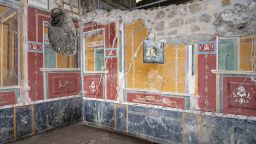
Researchers have recently uncovered significant architectural details of ancient Pompeii, revealing what they describe as the “lost Pompeii.” Utilizing advanced digital archaeology techniques, the team aims to reconstruct aspects of the city that were obscured by the catastrophic eruption of Mount Vesuvius in AD 79. This eruption buried the city beneath layers of ash and volcanic debris, preserving a snapshot of Roman life but leaving many structures unexamined.
The project, known as the Pompeii Reset, combines remote sensing technology, close-range photography, and traditional archaeological methods. This innovative approach is allowing researchers to identify previously hidden features, such as towers that signify wealth and power. According to Dr. Susanne Muth, a professor at Humboldt University of Berlin and co-lead author of the study, “By reconstructing the lost architecture, we gain a more nuanced and historically accurate understanding of the ancient city and life within it.”
Reconstructing a Lost World
Inspiration for this project came during a visit to the Archaeological Park of Pompeii in 2022. Muth recognized the need to preserve the fragile ruins while enhancing knowledge of the city’s daily life. The Archaeological Park partnered with Humboldt University, which has a strong focus on digital archaeology.
To document Pompeii’s structures, the team employs techniques like LiDAR (light detection and ranging) and high-resolution photography to create detailed 3D models. These models allow researchers to visualize how buildings may have appeared before the eruption. The investigations have revealed that some inhabitants returned to the city decades after the disaster, utilizing the ruins for various purposes.
Co-lead study author Gabriel Zuchtriegel, director of the Archaeological Park, explained, “The volcanic debris and ash covering Pompeii after the eruption reached approximately five meters in height.” He noted that surviving upper floors provided a glimpse into the resilience of the residents who lived among the ruins.
Insights into Upper-Class Life
As excavations progressed, renewed interest in the upper floors of Pompeii’s buildings emerged. Many earlier excavations focused primarily on lower levels, often overlooking upper stories thought to belong solely to the lower-class citizens of the city. Muth emphasized that these upper floors contained significant artifacts, revealing more about the lives of wealthier Pompeians.
The team turned their attention to the Casa del Tiaso, a luxurious residence that likely belonged to an influential family. Within its walls, they discovered a monumental stone staircase leading to a second floor. Notably, indentations in the walls suggested a possible wooden staircase that might have ascended to a third level, indicating that the residence could have included a tower.
Muth explained, “When we began to reconstruct this room in terms of its lost architecture, it became clear to us that it could only be a tower.” Such towers were emblematic of wealth and were typically used for social gatherings, offering expansive views of the surrounding landscape.
Towers in ancient Roman society are documented in various texts and paintings, indicating their popularity among the affluent. Yet, until now, archaeologists had not actively sought evidence of these structures within urban settings like Pompeii. Muth’s findings suggest that wealthy residences may indeed have included towers, a departure from the previously held belief that they were primarily found in rural villas.
The implications of this research extend to how we understand the social dynamics of Pompeii. The tower in the Casa del Tiaso may have served not only for leisure and banquets but also for astronomical observations, as astrology was a significant interest among Romans.
While some scholars have argued that the religious structure of ancient Rome limited the construction of taller buildings, Muth asserts that this newly uncovered evidence challenges those assumptions. The existence of towers could reflect a creative innovation by Pompeii’s elite, seeking to enhance their status in both the physical landscape and social hierarchy.
Digital Archaeology: A New Frontier
The process of digitally reconstructing Pompeii’s architecture is akin to detective work. Every detail is systematically documented and analyzed. Modern tools, including drones and laser scanning technology, facilitate the creation of highly accurate 3D models. This digital approach allows for a comprehensive understanding of architectural designs from multiple perspectives.
Muth highlighted the importance of accuracy in these models, stating, “Only when the building’s structural design is precisely recreated digitally in a 3D model can the architecture be understood and a plausible reconstruction developed.” This level of detail enables researchers to visualize various scenarios in Pompeii, from lavish banquets to the stark realities faced by the city’s working class.
Despite the promising findings, questions remain about the prevalence of towers in Pompeii. The research team continues to explore other areas of the city for additional evidence of upper floors and towers. As Dr. Marcello Mogetta, chair of the department of classics, archaeology, and religion at the University of Missouri, noted, “For those who could not take advantage of natural vistas, a tower-like structure was a clever solution — combining spectacle, visibility, and social signaling in one architectural gesture.”
Muth’s ultimate goal is to digitally reconstruct every room in the Casa del Tiaso and expand the project to include as many buildings as possible. This effort not only preserves Pompeii’s cultural heritage but also provides insights that could reshape our understanding of ancient urban life.
As the Pompeii Reset project progresses, it aims to illuminate the complexities of life in this ancient city, offering a glimpse into a world that has remained buried for nearly two millennia. With more than 13,000 rooms excavated since the mid-18th century, and a significant portion of Pompeii still concealed under ash, the potential for discovery remains vast.

New Jersey Risks Economic Growth by Neglecting Veteran Entrepreneurs

Fans Demand Canon for Top 20 Unofficial TV Couples

Study Reveals Promising Outcomes for Mismatched Blood Transplants

WJXT Secures Four Suncoast Emmys for Cultural Excellence

$1.25 Million Grant Fuels Hawaiʻi’s Advanced Hazard Monitoring Initiative

DraftKings Launches Exciting $300 Bonus for Missouri Sports Bettors

Dark Humor and Thrills Unfold in ‘Caught Stealing’ Adaptation

Long Butterfly Cut with Bangs Takes the Hair Trend Spotlight

László Krasznahorkai Engages Audience with Rare Lecture in Stockholm

Libraries Challenge Rising E-Book Costs Amid Growing Demand

Tyreek Hill Responds to Tua Tagovailoa’s Comments on Team Dynamics

Liverpool Secures Agreement to Sign Young Striker Will Wright

Save Your Split Tomatoes: Expert Tips for Gardeners

Princess Beatrice’s Daughter Athena Joins Siblings at London Parade

San Francisco Hosts Unique Contest to Identify “Performative Males”

Winter Storms Lash New South Wales with Snow, Flood Risks

Trump Administration Moves to Repeal Key Climate Regulation

SoFi Technologies Shares Slip 2% Following Insider Stock Sale
-
 Lifestyle5 months ago
Libraries Challenge Rising E-Book Costs Amid Growing Demand
-
 Sports4 months ago
Tyreek Hill Responds to Tua Tagovailoa’s Comments on Team Dynamics
-
 Sports4 months ago
Liverpool Secures Agreement to Sign Young Striker Will Wright
-
 Lifestyle4 months ago
Save Your Split Tomatoes: Expert Tips for Gardeners
-
 Lifestyle4 months ago
Princess Beatrice’s Daughter Athena Joins Siblings at London Parade
-
 Science4 months ago
San Francisco Hosts Unique Contest to Identify “Performative Males”
-
 World4 months ago
Winter Storms Lash New South Wales with Snow, Flood Risks
-
 Science5 months ago
Trump Administration Moves to Repeal Key Climate Regulation
-
 Business5 months ago
SoFi Technologies Shares Slip 2% Following Insider Stock Sale
-

 Science5 months ago
New Tool Reveals Link Between Horse Coat Condition and Parasites
-

 Sports5 months ago
Elon Musk Sculpture Travels From Utah to Yosemite National Park
-
 Science5 months ago
New Study Confirms Humans Transported Stonehenge Bluestones