
Science
New Algorithm Tackles Space Debris with Innovative Approach

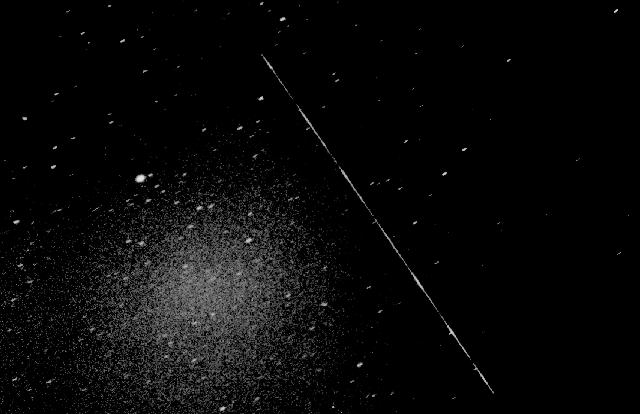
Space debris is an escalating concern, with tens of thousands of large fragments already in orbit, threatening functional satellites. To address this growing issue, researchers from GMV, a prominent player in the orbital tracking market in Europe, have developed a new algorithm aimed at understanding the movement of this debris. Their work, detailed in a recent paper, could significantly enhance efforts to mitigate the risks associated with orbital waste before they escalate into a situation known as Kessler Syndrome.
Understanding the behavior of space debris is critical for effective removal strategies. If satellites deployed to clear debris are not accurately informed about its movement, they might inadvertently exacerbate the problem. The challenge lies in determining how these uncontrolled objects are tumbling in space, a task that is particularly difficult from ground-based observations. Traditional telescopes typically capture only a single pixel of even the largest debris pieces, limiting the accuracy of assessments.
To overcome this limitation, the GMV researchers turned to a method used in astronomy known as a light curve. A light curve plots the brightness of an object over time, a technique that has been effective in tracking star activities and exoplanets. In the case of tumbling debris, different surfaces reflect sunlight variably. For example, shiny metal surfaces will reflect more light compared to dull solar panels. By analyzing changes in brightness over time, researchers can infer the rotation speed and direction of the debris.
The algorithm, named AISwarm-UKF, employs a sophisticated five-step process to estimate the debris’ orientation accurately. Instead of relying on a single guess, the algorithm initiates with thousands of potential orientations, using a statistical method called Bayesian inference to filter out less likely scenarios. This initial broad approach helps to mitigate errors that might arise from abrupt changes in the light curve, which can confuse the algorithm.
Following the initial filtering, the algorithm employs a technique known as Systematic Resampling, which boosts the weight of high-probability particles while discarding those deemed unlikely. This refinement is essential to ensure that computational resources focus on the most promising orientations. The next step, Particle Swarm Optimization, further directs these particles toward the best possible solution, preventing the algorithm from getting stuck in a local minimum—an issue that can lead to incorrect results.
The researchers also incorporated a clustering method called Density-Based Spatial Clustering to group particles around valid solutions. This is particularly important since the symmetry of satellites may make different orientations appear similar in light curves. By clustering potential solutions, users can more easily identify valid orientations that might otherwise be overlooked.
To validate the effectiveness of the AISwarm-UKF algorithm, the team conducted experiments using a simulated satellite and artificially generated light curves through a tool named Grail, also developed by GMV. Notably, the use of stereoscopic vision—gathering light curves from two distinct ground-based telescopes—significantly reduced ambiguity in the algorithm’s output. This improvement is attributed to the slight differences in captured light curves from different geographical locations, enhancing differentiation.
Ultimately, the AISwarm-UKF algorithm is expected to be integrated into a software package offered by GMV to various customers, including the German Space Situational Awareness Center and the Spanish Space Agency. As the issue of space debris continues to threaten the operation of existing satellites, tools like AISwarm-UKF will play an increasingly vital role in tracking and managing this growing concern. Through such advancements, the space community can hope to better protect valuable assets in Earth’s orbit.

Bulgaria’s Government Resigns Amid Mass Protests Before Eurozone Entry

Absolute Joker Seizes Batman’s Legacy in Shocking Twist

Physician-Developed Eyelash Serum Promises Rapid Transformation

Time Magazine Names Architects of AI as 2025 Person of the Year

Venezuelan Leader María Corina Machado Honored with Nobel Peace Prize

New Algorithm Tackles Space Debris with Innovative Approach

Chris Culliver to Transfer from UNC Football Program This Winter

China Targets Domestic Demand Growth in 2026 Policy Roadmap

Chris Culliver Announces Transfer from UNC Football Program

Libraries Challenge Rising E-Book Costs Amid Growing Demand

Tyreek Hill Responds to Tua Tagovailoa’s Comments on Team Dynamics

Liverpool Secures Agreement to Sign Young Striker Will Wright

Save Your Split Tomatoes: Expert Tips for Gardeners

Princess Beatrice’s Daughter Athena Joins Siblings at London Parade

San Francisco Hosts Unique Contest to Identify “Performative Males”

Winter Storms Lash New South Wales with Snow, Flood Risks

Trump Administration Moves to Repeal Key Climate Regulation

SoFi Technologies Shares Slip 2% Following Insider Stock Sale
-
 Lifestyle5 months ago
Libraries Challenge Rising E-Book Costs Amid Growing Demand
-
 Sports4 months ago
Tyreek Hill Responds to Tua Tagovailoa’s Comments on Team Dynamics
-
 Sports5 months ago
Liverpool Secures Agreement to Sign Young Striker Will Wright
-
 Lifestyle5 months ago
Save Your Split Tomatoes: Expert Tips for Gardeners
-
 Lifestyle4 months ago
Princess Beatrice’s Daughter Athena Joins Siblings at London Parade
-
 Science4 months ago
San Francisco Hosts Unique Contest to Identify “Performative Males”
-
 World4 months ago
Winter Storms Lash New South Wales with Snow, Flood Risks
-
 Science5 months ago
Trump Administration Moves to Repeal Key Climate Regulation
-
 Business5 months ago
SoFi Technologies Shares Slip 2% Following Insider Stock Sale
-

 Science5 months ago
New Tool Reveals Link Between Horse Coat Condition and Parasites
-

 Sports5 months ago
Elon Musk Sculpture Travels From Utah to Yosemite National Park
-
 Science5 months ago
New Study Confirms Humans Transported Stonehenge Bluestones