
Science
Earth Faces Hidden Threats from Cosmic Airbursts, Study Reveals

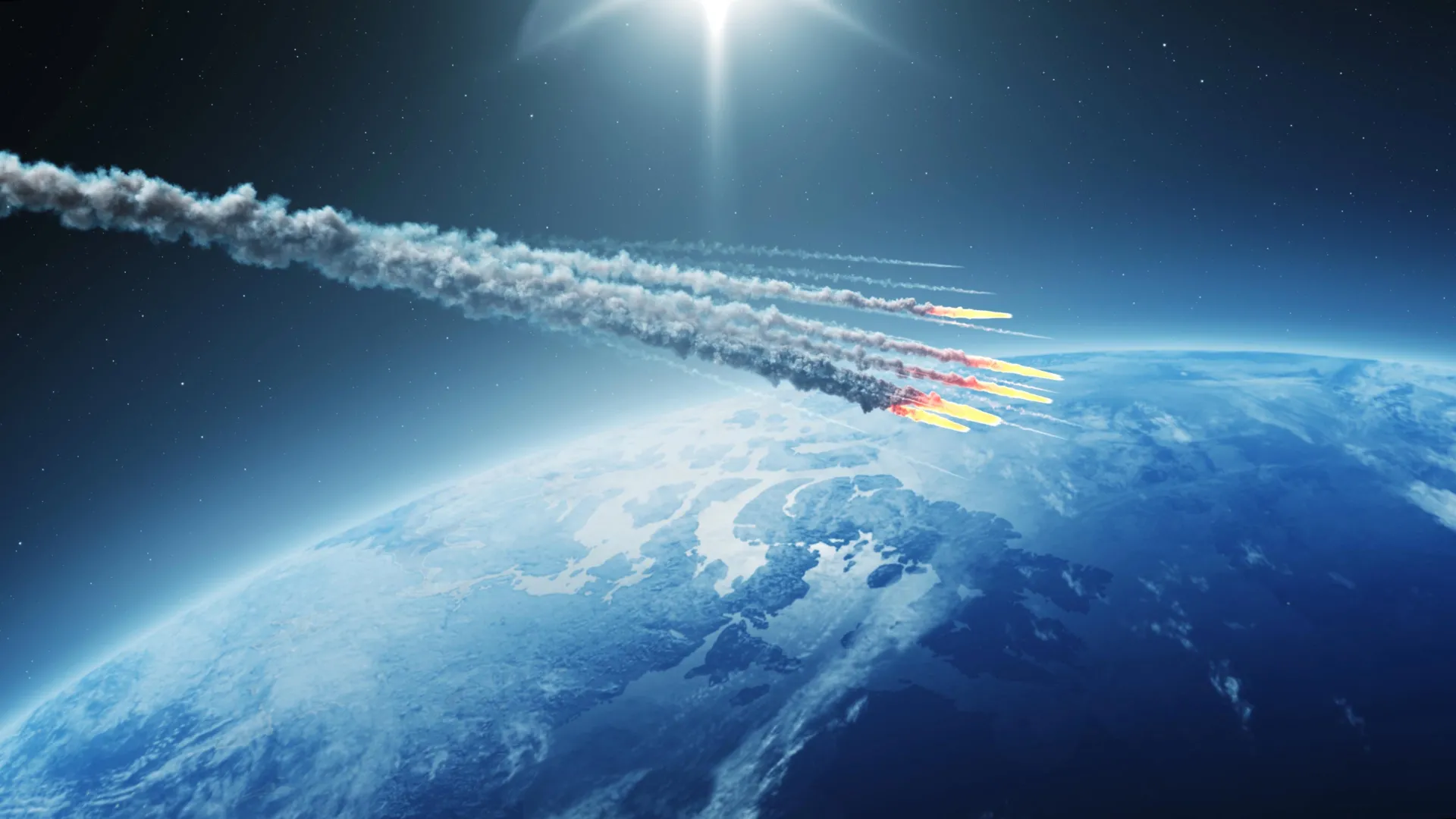
Recent research suggests that Earth may have experienced significantly more “invisible” explosions from space than previously understood. These cosmic events, known as “touchdown airbursts,” occur when comets or asteroids explode above the Earth’s surface, unleashing intense heat and pressure without leaving the visible scars typical of crater-forming impacts. This groundbreaking study, led by researchers at the University of California – Santa Barbara, emphasizes the destructive potential of these encounters, which merit further scientific inquiry.
According to James Kennett, an Emeritus Professor of Earth Science at UC Santa Barbara, touchdown airbursts can cause severe damage despite their lack of lasting geological evidence. “Touchdown events can cause extreme damage through very high temperatures and pressures,” he stated. “And yet they don’t necessarily form a crater, or they form ephemeral surface disturbances.”
Uncovering Evidence of Past Airbursts
The research team published four studies that collectively illustrate the occurrence of multiple airburst events throughout history. These explosions happen when a cosmic object detonates in the atmosphere, creating shockwaves and intense heat that affect the Earth’s surface. Evidence for these phenomena has been found across diverse locations, including deep ocean sediments in the North Atlantic and archaeological remains in ancient desert cities.
One study, featured in the journal PLOS One, reports the first discovery of airburst-related impact markers in marine sediments associated with the Younger Dryas Impact Hypothesis (YDIH). This material was unearthed from deep-sea cores in Baffin Bay, located off Greenland’s western coast. “This is significant because it’s the first time we’ve found evidence for the Younger Dryas cosmic impact event in the marine record,” Kennett remarked.
The Younger Dryas hypothesis posits that approximately 12,800 years ago, fragments of a comet exploded above Earth, triggering a global cooling event that substantially impacted ecosystems and human cultures. The explosions likely ignited widespread fires, leaving behind a distinctive carbon-rich layer known as a “black mat,” which has been identified in various Northern Hemisphere regions. This layer is characterized by high concentrations of platinum, iridium, metallic melt particles, shocked quartz, and meltglass.
The Quest for Craters
Unlike major impacts that leave craters as evidence, touchdown airbursts present a unique challenge for researchers. While large impacts create noticeable geological features, airbursts often leave minimal traces, complicating efforts to confirm their occurrence. Kennett noted that “there has been no evidence for the Younger Dryas boundary (YDB) event of any crater or possible crater.”
The research team highlighted a shallow seasonal lake near Perkins, Louisiana, which may represent the first known crater from the Younger Dryas Boundary. Historical observations from a landowner in 1938 noted the lake’s circular shape and “crater-like rim.” Investigations conducted from 2006 to 2024 revealed sediments containing meltglass and shocked quartz, with radiocarbon dating linking these materials to the Younger Dryas period. Nonetheless, further research is essential to validate the hypothesis that this lake formed from a cosmic impact.
In their studies, the team also revisited the infamous Tunguska event, which occurred in 1908 in Siberia. Traditionally, shocked quartz has been associated with large impacts, but the researchers argue that airbursts can produce a variety of fracture patterns. They analyzed samples from both the Tunguska site and Tall el-Hammam, an ancient city believed to have been destroyed by a similar airburst approximately 3,600 years ago.
Kennett pointed out that Tunguska is the only recorded historical touchdown event, with eyewitness accounts describing a bright fireball and extensive forest flattening. Despite extensive field studies, previous research had largely overlooked the search for microscopic impact evidence. The new findings represent a comprehensive identification of airburst-related materials at the Tunguska site, including shocked quartz with distinct fracture patterns and tiny impact-formed spheres.
The ongoing studies reinforce the view that cosmic impacts, particularly touchdown airbursts, may be far more frequent and destructive than previously believed. “They’re far more common, but also possess much more destructive potential than the more localized, classic crater-forming asteroidal impacts,” Kennett asserted. “The destruction from touchdown events can be much more widespread. And yet they haven’t been very well studied, so these should be of interest to humanity.”
This research underscores the need for greater awareness and understanding of the potential threats posed by these hidden cosmic phenomena. The implications for both scientific inquiry and global safety are profound, as the history of such events can inform future preparedness strategies.

Anthony Joshua Targets Knockout of Tyson Fury After Jake Paul Fight

Investors Secure Control of TikTok’s US Operations Through Joint Venture

Cryptocurrency Transforms Finance with Tokenization as New Backbone

DeepBook Protocol’s Future: Price Predictions for 2026-2030

Yoon Eun Hye’s Striking Fashion Stirs Attention on Social Media

Nurse Fails to Perform CPR, Investigation Reveals Neglect at Hilltop Healthcare

Bayern Munich Eyes Victory Against Heidenheim to Conclude 2025

UK Minister Confirms Cyber-Attack, Links to Chinese Hackers

Authorities Target Alleged Welfare Fraud in Boston Storefront Scam

Libraries Challenge Rising E-Book Costs Amid Growing Demand

Tyreek Hill Responds to Tua Tagovailoa’s Comments on Team Dynamics

Liverpool Secures Agreement to Sign Young Striker Will Wright

Save Your Split Tomatoes: Expert Tips for Gardeners

Princess Beatrice’s Daughter Athena Joins Siblings at London Parade

San Francisco Hosts Unique Contest to Identify “Performative Males”

Winter Storms Lash New South Wales with Snow, Flood Risks

Trump Administration Moves to Repeal Key Climate Regulation

SoFi Technologies Shares Slip 2% Following Insider Stock Sale
-
 Lifestyle5 months ago
Libraries Challenge Rising E-Book Costs Amid Growing Demand
-
 Sports5 months ago
Tyreek Hill Responds to Tua Tagovailoa’s Comments on Team Dynamics
-
 Sports5 months ago
Liverpool Secures Agreement to Sign Young Striker Will Wright
-
 Lifestyle5 months ago
Save Your Split Tomatoes: Expert Tips for Gardeners
-
 Lifestyle5 months ago
Princess Beatrice’s Daughter Athena Joins Siblings at London Parade
-
 Science4 months ago
San Francisco Hosts Unique Contest to Identify “Performative Males”
-
 World5 months ago
Winter Storms Lash New South Wales with Snow, Flood Risks
-
 Science5 months ago
Trump Administration Moves to Repeal Key Climate Regulation
-
 Business5 months ago
SoFi Technologies Shares Slip 2% Following Insider Stock Sale
-

 Science5 months ago
New Tool Reveals Link Between Horse Coat Condition and Parasites
-

 Sports5 months ago
Elon Musk Sculpture Travels From Utah to Yosemite National Park
-
 Science5 months ago
New Study Confirms Humans Transported Stonehenge Bluestones