
Science
Astronomers Discover Exoplanet Orbiting Twin Stars, Similar to Tatooine

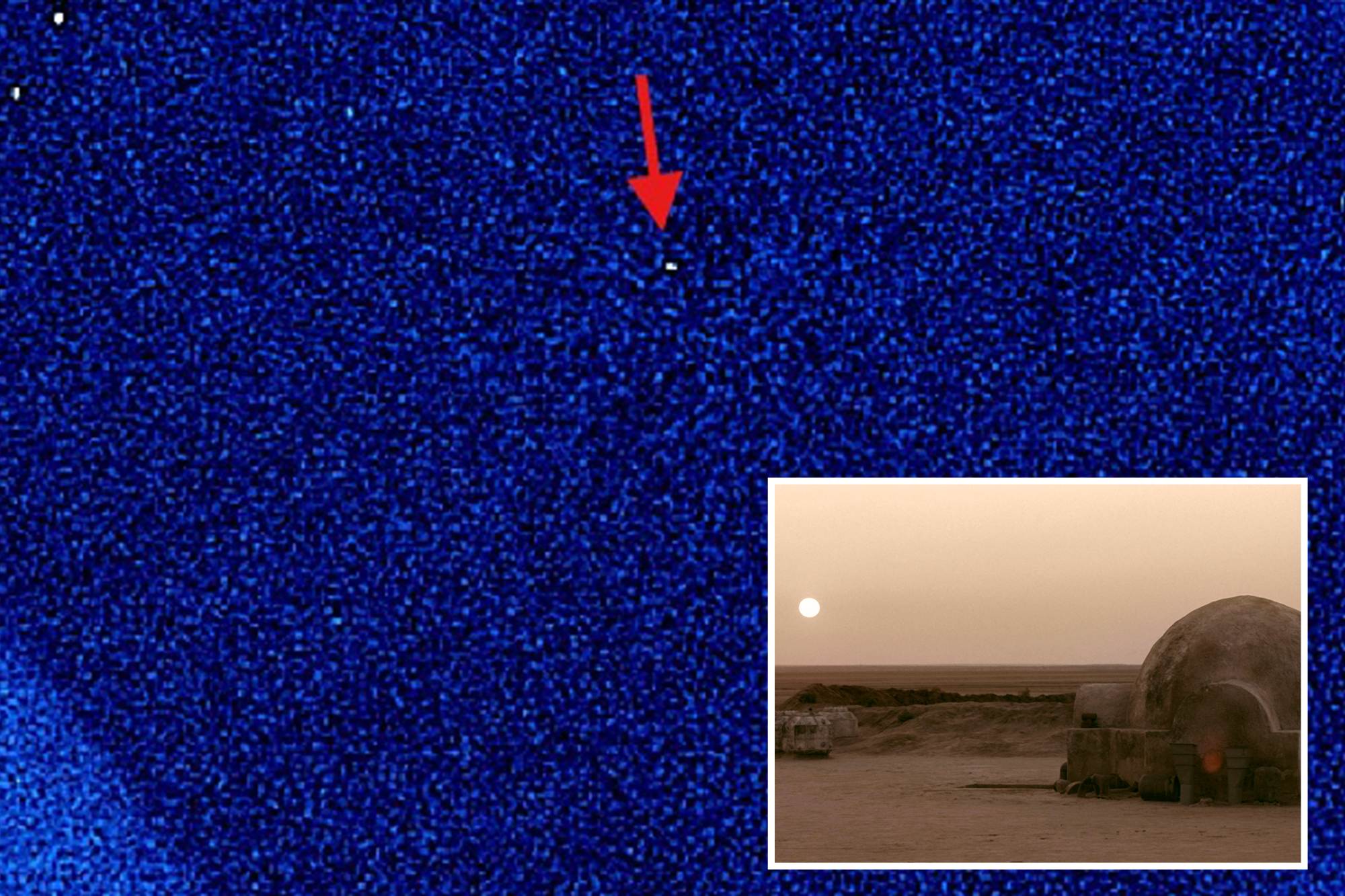
Astronomers have made a groundbreaking discovery with the identification of an unusual exoplanet, designated HD 143811 AB b, that orbits two stars closely in a binary star system. This significant finding was detailed in a study published in the journal Astronomy & Astrophysics. The planet, located approximately 446 light-years from Earth, shares similarities with the fictional planet Tatooine from the Star Wars saga, known for its twin suns.
Researchers from Northwestern University in Chicago, Illinois, released time-lapse imagery of HD 143811 AB b orbiting its luminous twin stars, which are closer than any previously recorded binary system exoplanet. This discovery offers astronomers a rare opportunity to analyze the trajectories of both the planet and the stars within this system.
According to Jason Wang, an expert in exoplanet imaging, “Of the 6,000 exoplanets that we know of, only a very small fraction of them orbit binaries.” He emphasized the significance of capturing images of both the planet and its binary stars, stating, “It’s the only type of planetary system where we can trace both the orbit of the binary star and the planet in the sky at the same time.”
Despite its proximity to its suns, HD 143811 AB b is still about 80 times further from its light sources than Earth is from the Sun. The planet takes about 300 years to complete one orbit around its stars, which themselves orbit each other once every 18 days. Notably, this gas giant is estimated to be six times the size of Jupiter.
Surprisingly, this is not a new discovery. The planet was uncovered from archival data collected a decade ago by the Gemini South telescope and its Gemini Planet Imager (GPI). Wang and his team revisited the data gathered between 2016 and 2019, cross-referencing it with information from the W.M. Keck Observatory. Their efforts led to the identification of a faint object moving alongside a star, which indicated that it was likely an orbiting planet.
Wang remarked on the significance of their findings: “If a planet is bound to a star, then it will move with the star.” He explained that if a planet does not move with its star, it is likely just a passing star. The confirmation of HD 143811 AB b as a planet was independently verified by astronomers from the University of Exeter in the UK.
Among the intriguing characteristics of HD 143811 AB b is its temperature of approximately 1,416°F, making it nearly twice as hot as Venus. The planet is also relatively young, estimated to be around 13 million years old, particularly when compared to Earth, which formed about 4.6 billion years ago.
The formation of this exoplanet around its twin stars remains uncertain. “Exactly how it works is still uncertain,” Wang stated, noting that the rarity of such systems makes it challenging to gather enough data for a comprehensive understanding. The research team plans to continue observing the orbits of the planet and its stars to gain further insights into the interactions between binary stars and their planets.
As astronomers delve deeper into this extraordinary discovery, the potential for new knowledge about planetary systems continues to expand. The study of HD 143811 AB b not only enriches our understanding of the cosmos but also connects the realms of science and popular culture through its resemblance to the iconic Tatooine.

Southwest Airlines Partners with Austin to Create 2,000 Jobs

Timothée Chalamet Sparks Speculation as EsDeeKid Identity Remains

Sherrod Brown Advocates for Affordable Care Act at Toledo Roundtable

Jobless Rate Gap Narrows Between High-School and College Graduates

Norman Mother Shares Impact of OKDHS Subsidies Amid Cuts

Astronomers Discover Exoplanet Orbiting Twin Stars, Similar to Tatooine

iRi NYC and New Year Market Launch Upcycled Charms Designed by Seniors

Duffer Brothers Reveal Major Details About ‘Stranger Things’ Season 5

L.A. Care Spotlights Community Health Leaders in Southern California

Libraries Challenge Rising E-Book Costs Amid Growing Demand

Tyreek Hill Responds to Tua Tagovailoa’s Comments on Team Dynamics

Liverpool Secures Agreement to Sign Young Striker Will Wright

Save Your Split Tomatoes: Expert Tips for Gardeners

Princess Beatrice’s Daughter Athena Joins Siblings at London Parade

San Francisco Hosts Unique Contest to Identify “Performative Males”

Winter Storms Lash New South Wales with Snow, Flood Risks

Trump Administration Moves to Repeal Key Climate Regulation

SoFi Technologies Shares Slip 2% Following Insider Stock Sale
-
 Lifestyle5 months ago
Libraries Challenge Rising E-Book Costs Amid Growing Demand
-
 Sports4 months ago
Tyreek Hill Responds to Tua Tagovailoa’s Comments on Team Dynamics
-
 Sports5 months ago
Liverpool Secures Agreement to Sign Young Striker Will Wright
-
 Lifestyle5 months ago
Save Your Split Tomatoes: Expert Tips for Gardeners
-
 Lifestyle5 months ago
Princess Beatrice’s Daughter Athena Joins Siblings at London Parade
-
 Science4 months ago
San Francisco Hosts Unique Contest to Identify “Performative Males”
-
 World4 months ago
Winter Storms Lash New South Wales with Snow, Flood Risks
-
 Science5 months ago
Trump Administration Moves to Repeal Key Climate Regulation
-
 Business5 months ago
SoFi Technologies Shares Slip 2% Following Insider Stock Sale
-

 Science5 months ago
New Tool Reveals Link Between Horse Coat Condition and Parasites
-

 Sports5 months ago
Elon Musk Sculpture Travels From Utah to Yosemite National Park
-

 Science5 months ago
New Study Confirms Humans Transported Stonehenge Bluestones