
Science
Researchers Achieve Lifelong Protein Control in Living Animals

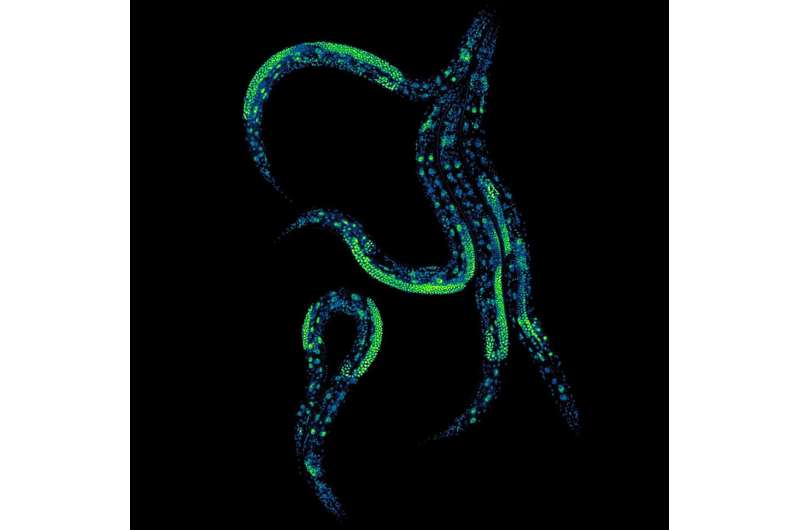
Researchers have developed a groundbreaking method to control protein levels in various tissues of a living organism for the first time. This significant advancement allows scientists to adjust protein concentrations with precision throughout the animal’s life, providing new insights into the molecular mechanisms of aging and disease. The study, conducted by a team from the Center for Genomic Regulation in Barcelona and the University of Cambridge, specifically focused on the nematode worm Caenorhabditis elegans, with findings published in the journal Nature Communications on December 12, 2025.
Implications for Aging and Disease Research
The new technique opens avenues for innovative experiments previously deemed impossible. Researchers can now investigate critical questions regarding optimal protein levels necessary for health and how small changes in a protein within one tissue might influence the entire organism. According to Dr. Nicholas Stroustrup, a researcher at the Center for Genomic Regulation and senior author of the study, “No protein acts alone. Our new approach lets us study how multiple proteins in different tissues cooperate to control how the body functions and ages.”
This method is particularly relevant for understanding systemic processes like aging, shaped by constant interactions among organs. Traditional methodologies often struggle to distinguish between the effects of proteins across different body parts, limiting insights into how these interactions drive aging and health over time.
Mechanism of the Dual-Channel AID System
The innovative approach is built on existing technology derived from plant biology. Plants utilize a hormone known as auxin to regulate growth. The auxin-inducible degron system, or AID system, was adapted from this principle. This system tags proteins with a degron, which is recognized by the TIR1 enzyme, prompting the targeted protein’s degradation when auxin is present. Removing the hormone allows the protein to return, facilitating reversible control.
By engineering various versions of the TIR1 enzyme and degrons, the research team created a more flexible dual-channel AID system. This system allows for nuanced control of protein levels, enabling scientists to dictate not only how much of a protein is present but also where and when this control occurs, all while the organism continues its normal functions, such as eating and moving.
The new technique involves genetically modifying the nematodes to produce the TIR1 enzyme in specific tissues. When these worms consume food containing auxin, the hormone activates TIR1, which then identifies the degron tag. This process enables precise regulation of protein levels.
A key advancement was the combination of two distinct TIR1 enzymes, each triggered by different auxin compounds, allowing independent control of the same protein in various tissues. The researchers also addressed challenges associated with previous AID systems that often failed in reproductive tissues, successfully adapting their method to function across the entire organism, including reproductive cells.
As noted by Dr. Jeremy Vicencio, a postdoctoral researcher at the Center for Genomic Regulation and co-author of the study, “Getting this to work was quite an engineering challenge. We had to test different combinations of synthetic switches to find the perfect pair that didn’t interfere with one another. Now that we’ve cracked it, we can control two separate proteins simultaneously with incredible precision. It’s a powerful tool that we hope will open up new possibilities for biologists everywhere.”
The implications of this research extend beyond basic science, potentially transforming fields such as regenerative medicine and therapeutic development. As scientists continue to explore the intricate interplay of proteins in living organisms, this new technique promises to enhance our understanding of biological processes and pave the way for future innovations in health and medicine.

Fort Worth Hosts Exciting Hometown Half Marathon and 5K/10K Events

Navy Launches Five New Acquisition Executives to Streamline Processes

Utah Mother Kouri Richins Accused of Poisoning Husband for Money

Oil Prices Surge, U.S. Stocks Show Unexpected Resilience

Cyberpunk 2077 Set for PS5 Pro Performance Update Soon

Home Assistant Tool Enhances Server Health with Global Score

Oregon Ducks Unveil Nature-Inspired Nike Air Max 95 Sneakers

Trump Administration’s Legal Tactics Intensify at the Border

Sandia Scientists Recognized as National Academy of Inventors Fellows

Libraries Challenge Rising E-Book Costs Amid Growing Demand

Tyreek Hill Responds to Tua Tagovailoa’s Comments on Team Dynamics

San Francisco Hosts Unique Contest to Identify “Performative Males”

Liverpool Secures Agreement to Sign Young Striker Will Wright

Astronomers Unveil Insights from β Pictoris b Using GRAVITY

University of Hawaiʻi Joins $25M AI Initiative to Monitor Disasters

Save Your Split Tomatoes: Expert Tips for Gardeners

Elon Musk Sculpture Travels From Utah to Yosemite National Park

California Develops New Method to Monitor Toxic Algal Blooms
-
 Lifestyle10 months ago
Libraries Challenge Rising E-Book Costs Amid Growing Demand
-
 Sports9 months ago
Tyreek Hill Responds to Tua Tagovailoa’s Comments on Team Dynamics
-
 Science8 months ago
San Francisco Hosts Unique Contest to Identify “Performative Males”
-
 Sports9 months ago
Liverpool Secures Agreement to Sign Young Striker Will Wright
-
 Science7 months ago
Astronomers Unveil Insights from β Pictoris b Using GRAVITY
-
Science6 months ago
University of Hawaiʻi Joins $25M AI Initiative to Monitor Disasters
-
 Lifestyle9 months ago
Save Your Split Tomatoes: Expert Tips for Gardeners
-
 Sports9 months ago
Elon Musk Sculpture Travels From Utah to Yosemite National Park
-
 Science9 months ago
California Develops New Method to Monitor Toxic Algal Blooms
-

 Lifestyle9 months ago
Princess Beatrice’s Daughter Athena Joins Siblings at London Parade
-

 Sports9 months ago
Bubba Wallace Makes History with Brickyard 400 Victory
-

 World9 months ago
Winter Storms Lash New South Wales with Snow, Flood Risks