
Science
Scientists Uncover Ancient Secrets and Cosmic Wonders This Week

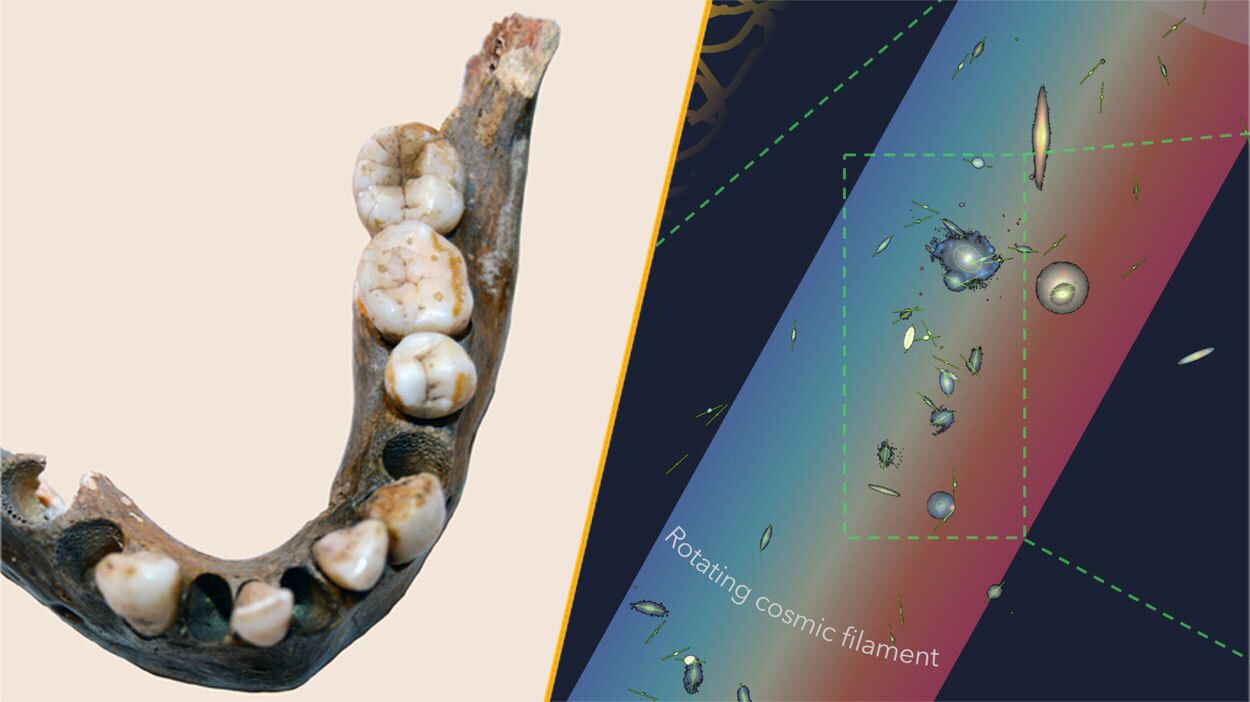
This week, scientific discoveries spanned vast distances from the depths of space to ancient Earth, revealing remarkable insights about our universe and human history. Among the highlights is the identification of the largest spinning object in the known universe, located approximately 140 million light-years away. Researchers discovered this colossal rotating filament, which is wider than the Milky Way, linked to a chain of 14 galaxies. The filament is spinning at an astonishing 110 kilometers per second (68 miles per second).
Closer to home, a groundbreaking study in southern Africa unveiled a human population that remained genetically isolated for an extraordinary 100,000 years. Researchers investigated skeletons dating back up to 10,000 years, found south of the Limpopo River, which flows through South Africa and Mozambique. The remains showed a genetic makeup starkly different from contemporary humans, suggesting these individuals “form an extreme end of human genetic variation,” according to the study.
In a significant archaeological find, a team in China unearthed a pit filled with skulls near a 4,000-year-old city. Notably, nearly all the skulls belonged to males, presenting a puzzling contrast to sacrificial patterns observed in other nearby sites. Meanwhile, in Greece, archaeologists were intrigued by a 2,700-year-old elaborate tomb containing a woman adorned with an upside-down crown, raising questions about ancient burial practices.
On a more modern note, an extensive tree-planting initiative known as the Great Green Wall in China aimed at combating desertification has resulted in unexpected ecological changes. A recent analysis revealed that while the project successfully halted desert spread, it also altered rainfall and evaporation patterns across the country, resulting in lower water levels in several densely populated regions.
In another intriguing development, research suggests the historic temperature record of 56.7 degrees Celsius (134 degrees Fahrenheit) set in Death Valley in 1913 may have been influenced by human error. Additionally, scientists warned that the potential collapse of a key Atlantic current could lead to prolonged drought conditions in Europe.
Further capturing the public’s imagination, the interstellar comet 3I/ATLAS is exhibiting signs of “ice volcanoes,” as recent images reveal spiral jets erupting from its surface. Observations made using the Joan Oró Telescope in northeastern Spain indicate that as the comet approaches the sun, it heats up and brightens, suggesting sublimation of ice, akin to other objects in our solar system.
In technological advancements, engineers at MIT have developed a method to extract drinking water from air in just minutes. Their innovative approach utilizes sound waves to effectively harvest moisture, achieving 45 times more efficiency than traditional evaporation methods. Although the device requires a power source, researchers propose pairing it with a solar cell to overcome this limitation.
The week also saw significant discoveries in various fields. A new study on broken objects has unveiled the law of “maximal randomness,” explaining why they often shatter in frustratingly unpredictable ways. Moreover, preliminary research indicates that injecting anesthetic into a “lazy eye” may help correct vision issues, and findings suggest that anacondas evolved to become massive around 12 million years ago.
In a more hopeful exploration, scientists are investigating ancient rock formations beneath the Earth’s crust that could harbor vast, carbon-free helium reservoirs. These discoveries may hold the key to addressing the looming helium shortage, crucial for technologies ranging from MRI machines to quantum computers.
As scientists continue to unravel these mysteries, the implications for our understanding of both the cosmos and human history remain profound. The week’s discoveries not only highlight the tenacity of scientific inquiry but also inspire curiosity about the universe and our place within it.

Tech Blogger Unveils Fleet of Flying Sword Drones in Chengdu

Texas Democrats Navigate Turbulent Political Landscape Post-Ruling

New Study on Moonquakes Raises Concerns for NASA’s Lunar Plans

UFC 323 Highlights: Wrestling Observer Radio Recaps Key Events

Soldiers Claim Control in Benin Ahead of Presidential Election

Microsoft Responds to Feedback, Makes Windows 11 AI Actions Optional

Roivant Sciences Hits 52-Week High; Analysts Adjust Ratings

Robert Eggers’ ‘The Northman’ Thrives on Netflix After Theatrical Struggles

Ensight Skills Center Empowers Coloradans with Vision Loss

Libraries Challenge Rising E-Book Costs Amid Growing Demand

Tyreek Hill Responds to Tua Tagovailoa’s Comments on Team Dynamics

Liverpool Secures Agreement to Sign Young Striker Will Wright

Save Your Split Tomatoes: Expert Tips for Gardeners

Princess Beatrice’s Daughter Athena Joins Siblings at London Parade

San Francisco Hosts Unique Contest to Identify “Performative Males”

Winter Storms Lash New South Wales with Snow, Flood Risks

Trump Administration Moves to Repeal Key Climate Regulation

SoFi Technologies Shares Slip 2% Following Insider Stock Sale
-
 Lifestyle5 months ago
Libraries Challenge Rising E-Book Costs Amid Growing Demand
-
 Sports4 months ago
Tyreek Hill Responds to Tua Tagovailoa’s Comments on Team Dynamics
-
 Sports4 months ago
Liverpool Secures Agreement to Sign Young Striker Will Wright
-
 Lifestyle4 months ago
Save Your Split Tomatoes: Expert Tips for Gardeners
-
 Lifestyle4 months ago
Princess Beatrice’s Daughter Athena Joins Siblings at London Parade
-
 Science4 months ago
San Francisco Hosts Unique Contest to Identify “Performative Males”
-
 World4 months ago
Winter Storms Lash New South Wales with Snow, Flood Risks
-
 Science5 months ago
Trump Administration Moves to Repeal Key Climate Regulation
-
 Business5 months ago
SoFi Technologies Shares Slip 2% Following Insider Stock Sale
-

 Science5 months ago
New Tool Reveals Link Between Horse Coat Condition and Parasites
-

 Sports4 months ago
Elon Musk Sculpture Travels From Utah to Yosemite National Park
-
 Science5 months ago
New Study Confirms Humans Transported Stonehenge Bluestones