
Science
Study Confirms Nanotyrannus as Distinct Species from T. rex

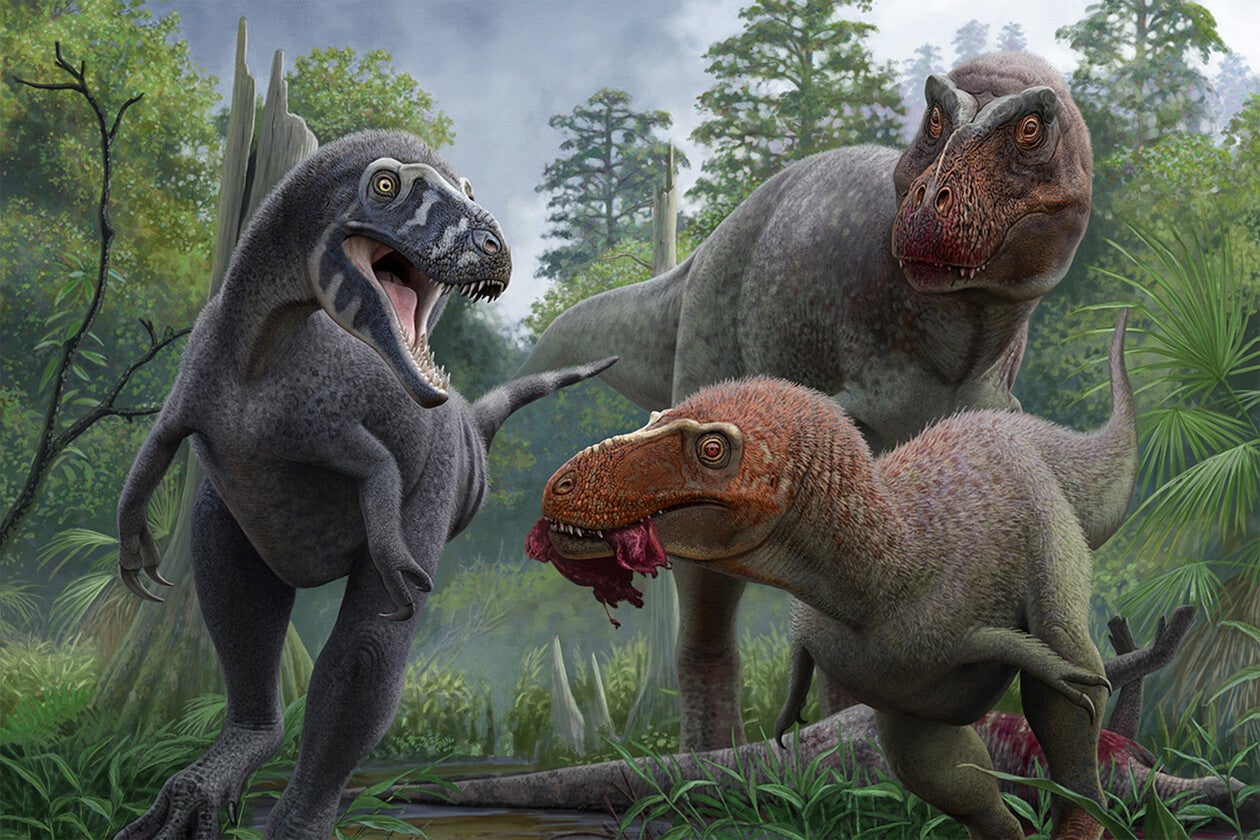
A recent study published in the journal Science has determined that Nanotyrannus lancensis, long believed to be a juvenile version of Tyrannosaurus rex, is in fact a separate species. This conclusion aligns with findings from another study in Nature, further solidifying the distinction between these two iconic dinosaurs.
For decades, paleontologists have debated the classification of Nanotyrannus, often referring to it as a “Teen” rex. The new research draws extensively on the fossil collection at the Yale Peabody Museum, where first author Christopher Griffin, a curatorial affiliate and assistant professor of geosciences at Princeton University, conducted much of the analysis.
The study addresses a longstanding challenge in dinosaur paleontology: how to differentiate between species and their growth stages. Griffin remarked, “Whether two individuals are different species or just different growth stages of the same species is a persistent problem in dinosaur paleontology.” He emphasized that the new findings provide a method for assessing maturity in specimens that lack limb bones, which is crucial for understanding the dinosaur fossil record.
Determining the maturity of dinosaurs typically involves analyzing growth rings in limb bones, akin to counting tree rings in trees. However, the holotype of Nanotyrannus is an isolated skull without limbs. Consequently, Griffin and his team investigated the throat bones, known as hyoids, to assess maturity. They compared the hyoids of modern relatives of dinosaurs, such as birds and crocodiles, and fossil specimens like Allosaurus to validate their method.
The analysis revealed that the hyoid of Nanotyrannus exhibited characteristics indicative of a fully mature individual. Griffin noted, “This is the first direct determination of maturity for the holotype specimen, the specimen that holds the name Nanotyrannus lancensis and defines the species.” This finding confirms that the holotype itself represents a distinct species rather than a juvenile version of T. rex.
Most of the research was conducted at Yale, with the Peabody collections providing essential samples of hyoids, limb bones, and ribs from various species. Griffin praised the Peabody collections, stating, “They were a crucial piece in showing that this new method was viable.”
The implications of this study extend beyond the classification of Nanotyrannus. Researchers suggest that the findings may reshape understandings of the developmental stages of T. rex and indicate a greater diversity of carnivorous dinosaurs. This increased diversity suggests more complex ecological interactions among the last non-avian dinosaurs in North America.
Funding for this important research was provided by a National Science Foundation Postdoctoral Research Fellowship, enabling Griffin and his team to contribute valuable insights into the world of paleontology. As the debate over the classification of Nanotyrannus comes to a close, it opens new avenues for understanding the evolutionary history of these remarkable creatures.

New Jersey Risks Economic Growth by Neglecting Veteran Entrepreneurs

Fans Demand Canon for Top 20 Unofficial TV Couples

Study Reveals Promising Outcomes for Mismatched Blood Transplants

WJXT Secures Four Suncoast Emmys for Cultural Excellence

$1.25 Million Grant Fuels Hawaiʻi’s Advanced Hazard Monitoring Initiative

DraftKings Launches Exciting $300 Bonus for Missouri Sports Bettors

Dark Humor and Thrills Unfold in ‘Caught Stealing’ Adaptation

Long Butterfly Cut with Bangs Takes the Hair Trend Spotlight

László Krasznahorkai Engages Audience with Rare Lecture in Stockholm

Libraries Challenge Rising E-Book Costs Amid Growing Demand

Tyreek Hill Responds to Tua Tagovailoa’s Comments on Team Dynamics

Liverpool Secures Agreement to Sign Young Striker Will Wright

Save Your Split Tomatoes: Expert Tips for Gardeners

Princess Beatrice’s Daughter Athena Joins Siblings at London Parade

San Francisco Hosts Unique Contest to Identify “Performative Males”

Winter Storms Lash New South Wales with Snow, Flood Risks

Trump Administration Moves to Repeal Key Climate Regulation

SoFi Technologies Shares Slip 2% Following Insider Stock Sale
-
 Lifestyle5 months ago
Libraries Challenge Rising E-Book Costs Amid Growing Demand
-
 Sports4 months ago
Tyreek Hill Responds to Tua Tagovailoa’s Comments on Team Dynamics
-
 Sports4 months ago
Liverpool Secures Agreement to Sign Young Striker Will Wright
-
 Lifestyle4 months ago
Save Your Split Tomatoes: Expert Tips for Gardeners
-
 Lifestyle4 months ago
Princess Beatrice’s Daughter Athena Joins Siblings at London Parade
-
 Science4 months ago
San Francisco Hosts Unique Contest to Identify “Performative Males”
-
 World4 months ago
Winter Storms Lash New South Wales with Snow, Flood Risks
-
 Science5 months ago
Trump Administration Moves to Repeal Key Climate Regulation
-
 Business5 months ago
SoFi Technologies Shares Slip 2% Following Insider Stock Sale
-

 Science5 months ago
New Tool Reveals Link Between Horse Coat Condition and Parasites
-

 Sports5 months ago
Elon Musk Sculpture Travels From Utah to Yosemite National Park
-
 Science5 months ago
New Study Confirms Humans Transported Stonehenge Bluestones